When Waiting Is Fine
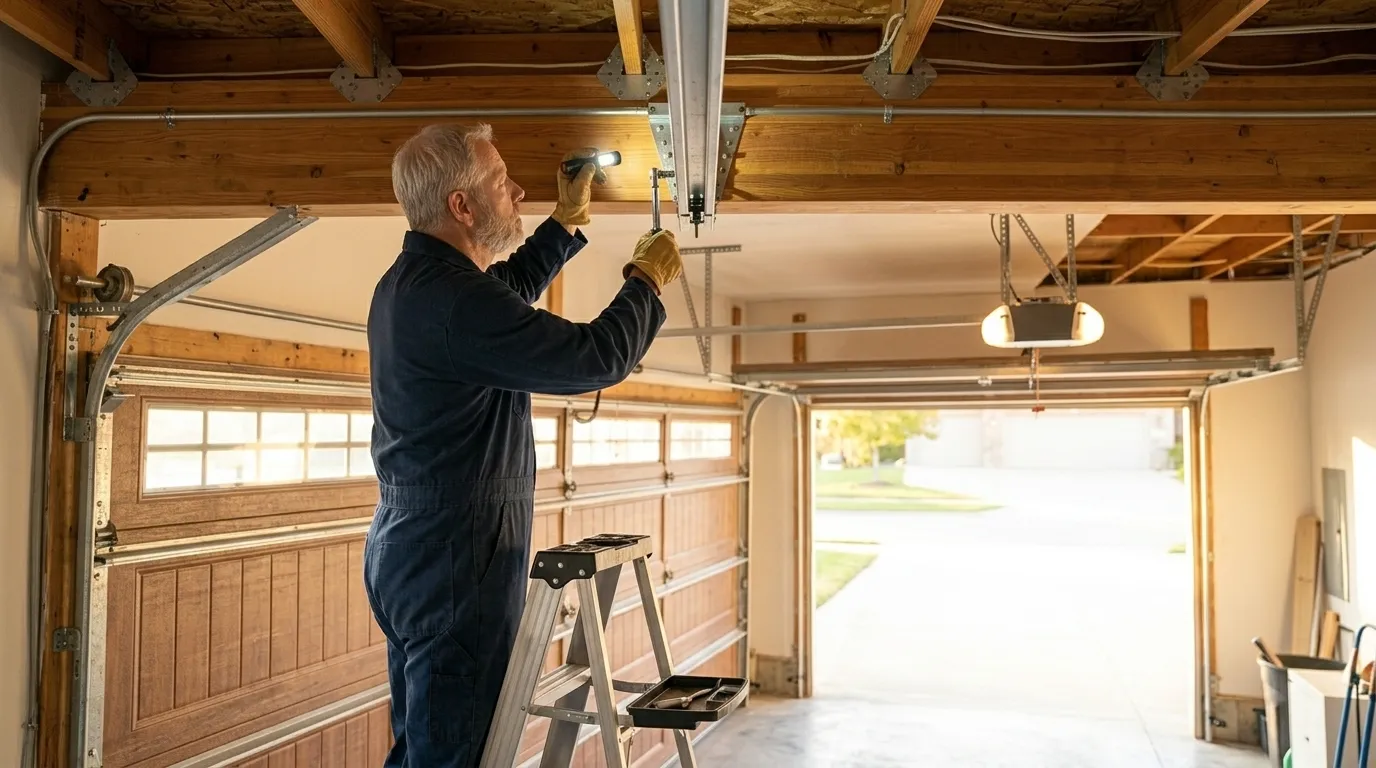
Most of the time, a power cut doesn't mean you're stuck. Every opener built since the chain-drive units common in this area's 1980s and 90s housing stock has a manual release cord - the red handle hanging near the rail. Pull it, and the trolley disconnects from the opener carriage, letting you lift the door by hand like it's 1970 again. If the door was balanced correctly before the outage, this takes one hand and a few seconds.
If you're leaving for work and the power's out, pull the cord, lift the door, and re-engage it when you get home and the lights are back. There's no reason to call anyone for a door that still moves freely on manual release. The only real question is whether you can lift it yourself - a heavier double door on a worn spring is a different story, and that's not something a power cut caused, it's something that was already there.
Where it stops being fine to wait: if the door won't budge even disengaged, or if it drops instead of holding its position when you let go. That's a spring problem, not a power problem, and it doesn't fix itself when the electricity comes back.
What It Costs
There's no single number to quote here, because the range depends entirely on what you're starting with. If your opener already has a battery backup unit and it's just old or dead, that's a battery swap. If your opener predates backup as a feature - likely for houses from this area's main 1980s-90s building wave - adding backup means retrofitting a compatible unit or, in some cases, replacing the opener outright if the motor head doesn't support one.
We won't quote a number without seeing the opener, the door weight, and whether the existing wiring and rail can take a retrofit kit versus needing a full head swap. What we will say honestly: if your opener is already near the end of its working life for other reasons - noisy, slow, skipping the safety reversal test - it usually makes more sense to replace it with a battery-backup-equipped unit than to bolt a backup accessory onto a motor that's already failing. Fixing the outage problem on a dying opener just delays the real repair.
Ask for a look at the specific unit before assuming either direction. Guessing at cost from the phone isn't something we do.
How Local Conditions Play In
Where you sit in the area changes what a power cut actually looks like. West University, about a mile southeast, and Northeast Reno, three miles east, sit close to the core grid and tend to see outages resolve faster. North Valleys, seven miles north, and areas further out like Cold Springs and Spanish Springs at twelve miles, are more exposed when a storm brings down lines - the same cold-and-severe climate pattern that drives the outage in the first place also means those farther pockets can wait longer for a crew to reach them.
Sun Valley at six miles and Verdi at seven sit in between - not immune, but usually not last in line either. None of this changes what your opener does during the outage; it changes how long you're relying on the manual release before power (and the opener) come back online.
The practical takeaway: if you're on the outer edge of the service area, backup power for the opener buys you more than it would somewhere closer in, simply because your outages tend to run longer. That's worth factoring in if you're already deciding whether to add a battery unit.